Showing posts with label wildlife. Show all posts

Sunday, February 15, 2009

Southern Culture, Part Two of Many (Grabbling)

So, right. No updates. This is because I am trying to write something about the Australia wildfires, settle into my new job and home, and survive the California DMV.

These days, I would say I am homesick for North Carolina. Don't get me wrong, California is great. But North Carolina has a lot of character you don't find elsewhere, and I miss being there.

While I am working on my Australia piece, I'll post a piece I wrote about grabbling in NC.

*****

What do you do in a small Southern town at nights and on weekends? I believe there is a bar in town, but I have still not spent any time exploring Rockingham beyond finding its Chimney Swifts. There isn’t a movie theater, that I know. Nights at home can be fun when the other biologists are staying here, and sure, there’s always Seventeen-Frog Pond (now featuring 21 species of frogs and toads!), but at this time of year the frogs are mostly hanging out under the mud, and even field biologists need to go out and see people once in a while. So while we wait for the NASCAR raceway to reopen, I pass time with other local sports.


Southern Culture, Part Two of Many (Grabbling)


Lincoln invites me out mountain biking. Though I have no talent or ability in this, and no pressing desire to exercise in hundred-degree weather, I am promised a swim in the river, and this is the Diggs Tract we’re discussing here. “I’m taking you grabblin’”—says Lincoln.

We fill a chest full of ice, some water and a few beers, and head out to the river from work. We park Lincoln’s white pickup as far out of sight as possible, and offload two mountain bikes. He says we’re going to get the catfish back up the path on the bike, tied lengthwise to its side, or carry one in the backpack, tail flapping out the top if we get two. He tosses me a length of rope, and we bike many miles over pebbles and rocks and clay and torn up ground, through the oppressive humidity and down to the river.

Lincoln cuts a straight branch and whittles the end into a sharp point with the case knife he carries on his belt. He hands me this makeshift spear, and I strap it to my back with the rope. I think the idea is that if we find one of these monster fishes, we are going to poke it with the stick. This sounds like a plan put together by a four-year-old, but since I don’t have a better one, I assent. We leave whatever clothing we can do without, the backpack and our water bottles in an out-of-the-way wooded cove.

We float down the river on our stomachs for about an hour, arms and legs spread out, hands roving through the water to sense the sharp and unexpected architectures of the riverbed. Sometimes the water is deeper than we can stand in, and then all at once, we are crawling over a rocky landscape just inches from the surface. The rock drops away, and we are once again floating in unknown depths. The water is warm and the air is warmer. Sweetgums and oaks and poplars crowd clay banks that sit opposite one another at a distance of one hundred fifty meters. This year’s drought, combined with the previous year’s, layered on the one from the year before that, has dropped the water level down many feet from where it should be, and so the gentle push of the river is no threat to us. Sometimes a grabbler will get carried away downstream, and you hope he hauls out safely, as you dare not follow his lead. But the current is lazy, and the sun is shining. The world seems simple and beautiful. It is a moment in which I can’t think of anything I would rather be doing.

During our float, Lincoln explains that the spear is used to antagonize the fish. Occasionally you find a catfish that does not want to bite you, and if you are committed to a successful grabbling encounter, you need to punch and prod the fish until it is angry enough to swallow your hand and hang on. The next part is a battle of strength as the fish tries to retreat with its living bait, and you try in earnest to retrieve your ingested limb. The catfish may hold you underwater. It may break your wrist when it thrashes. It may try to pull you into its den. The rock that the fish lives in will bump and thump and boom and rumble, though it may be solid throughout and weigh more than a ton. The rope is reserved for occasions when you win. You string one end of it through the mouth and gills of the fish, and the other around your waist. You swim back up the river, and the fish travels behind you as docile and fine as a water-breathing lapdog.


Lincoln shows me a flat-topped rock as big around as a picnic table, which sits just below the water line. He calls it Lost Rock. He drops underwater, spends about a minute probing the cavity, making sure that there is no fish underneath. He surfaces and tells me it’s my turn.

“I don’t want to do this!” I balk. “This is a terrible idea! And I don’t feel like drowning today,” I pout. I am experiencing a sudden change in mood at the prospect of provoking a leviathan to attack me in an environment where I cannot see, nor hear, nor breathe. I have Lincoln’s assurance that the fish is gone, but I am not confused about the value of a trickster’s word.

“Young lady”—says Lincoln—“if you don’t dahv down there and stick your hand under that rock, ah will drown you mahself.”

I weigh my options, and find them exactly equal. I decide that I might rather take on an unknown beast than irritate Lincoln, who is sporting a serious look. I drop onto my belly underwater, and he stands on my back to keep me there. At the base of the rock is a hole, and I feel around the edge of it with my spear. The opening is about the size and shape of a fat, swaybacked dachshund. I stick the spear in and encounter nothing. I thrust the spear in the other side, and still nothing. I wave it back and forth. More nothing. I put my hand in. Nothing.

At this point, I am less surprised by the absence of the fish as by the vastness of the expanse beyond that opening. The space is rocky, but wide, and it reaches upwards towards the surface. It is an underwater cathedral I am exploring, blind. There is space under this rock—cavernous, unbelievable space. A person could fit in there easily, maybe even two. It would be nothing to load dachshunds into there, one after another. It’s this kind of permanently dark, hidden room that a Flathead Catfish seeks out to live in and lay eggs. I have an underwater sense, like smell, of a swampy, rank fishiness of the previous resident.

Lincoln is standing on me, and I am out of air. I pause for an extra moment to consider the possible outcomes of this situation and question, as always, the wisdom of my actions. I struggle under his feet, and he lets me up without testing me. Though unpredictable, Lincoln sometimes chooses to play big brother to me and has at times shown kind concern for my safety. I’m not going to drown today, which is good, because I’m about ready for that beer.

“You smell ‘im?” —Lincoln asks. I nod. I gasp for breath—“Do catfish just keep showing up here when you take one out?” A nod from Lincoln. “Why?” I demand excitedly. “Underwater, it’s still just lahk the forest. It’s cavity-limited,” says Lincoln. I think of all the birds and squirrels and raccoons and opossums and bats fighting for the few hollow logs that seem to be out there, and I wonder with new interest at the life of a fish.

We visit another grabbling rock, which has a cavity about like a rugby ball. Blue Rock also lacks an occupant, as does Great Rock. It’s late in the season to catch a catfish, but this fails to trouble me. I call it a grand success that I have not had to kill a fish with my bare hands, or haul forty pounds of dead-weight back up the hill on a bicycle. Let these non-native beasts sit and eat up all the other little fishes until someone else comes to grabble them.

Monday, August 25, 2008

Letters Home


I began a series of letters when I moved from Massachusetts to North Carolina. I couldn't have prepared myself for the move, or what I would be doing... I was more used to cities than wild areas. I knew no one, had no family in the south, but even though it was a big chance to take, it was worth it.

I'll start posting the letters I wrote home, sequentially, over the next month or so.

--------------

Hi Everyone-

I have arrived safely in North Carolina.

I live in Rockingham, a town with its own Wal-Mart. Nine thousand people live here, and I'll give you one guess where you can find them. I live in the bird sanctuary on a gorgeous lake. We are overrun with birds, lizards, and dragonflies. I work in Hoffman, a town of 600 people. They have a rusty water tower, and that's about it… a post office that could fit into my current bedroom, and two gas stations. Though in Rockingham proper, it appears that Hoffman has a raceway that seats 78,000 people, but since the raceway was closed down in order that a much larger, 115,000-seater could be built further north, there's not much going on out there. I will say that after a day in the Sandhills, I am happy to see these signs of "civilization."

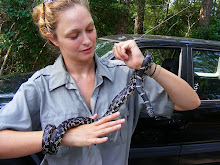
I live with a fire technician named Jake, who, like the rest of the burn crew, has a slightly cooked look to him. Jake is an easy-going, drawling Hoosier who enjoys taking extreme close-ups of deadly snakes. He knows an incredible amount about the local wildlife, and we spend nice evenings out on the porch with our binoculars and field guides, when we are not watching "the Channel," in this case CBS, and scrutinizing "Survivor, Fiji" for wilderness survival tips. Occasionally, other scientists stay here with us, and some sort of bizarre two-for-one sale brings us a second "fire-technician Jake" next month as our final permanent roommate.

Day One in the Sandhills Wildlife Depot managed to seem both completely ordinary and completely foreign simultaneously, making me think that I have not quite resolved into which of the "many universes" from quantum theory I am destined to inhabit. There was the normal paperwork to fill out, I-9's to file, direct deposit forms, and so on. For the project, papers on Bachman's sparrows and Red-Cockaded woodpeckers to collect and study, field equipment to gather and store in the field truck. This time, I have a tow-chain and snake chaps in addition to clipboards, data sheets, and nest-monitoring tools. At lunch, though, I was sitting down with men named "Rupert," "Lincoln" and "Lee," sharing the cornbread and stew. I remarked that the vertebra that I happened to be chewing on seemed awfully mammalian. A long pause. "That's whah ah shoot mah rabbits in the heyud," offered Lincoln obliquely, spitting out a piece of lead shot. That guy cracks me up.

Later in the day, we visited the sites I will be studying. Most of them are Longleaf pine restorations, host to trees sporting hundreds of goofy green pom-poms and some very rare birds. There are also "the drains," which seem to be some sort of hell reserved specifically for ornithologists. Each site offers particular challenges, but let me back up a little.

North Carolina has taken a cue, perhaps the wrong kind of cue, from Smokey the Bear, and has introduced into the conservation panoply "Burnin' Bob White" (a small quail with a large rake) and "Drip Torchin' Tom Turkey." Go ahead and read that out loud. Drip-Torchin' Tom Turkey is a biologically accurately drawn turkey, wing outspread, pouring burn fuel on the ground with a tool that might be recognizable to fire technicians, but otherwise requires the unlikely name of its possessor to provide a clue as to its function. I know it sounds improbable, but this is North Carolina's plan for converting the masses to the environmental mindset. Given what I've seen of the predominant culture here, I think they might do better with Jesus in flame-retardant robes, or Jesus in a burning pine forest, or even just a bumper sticker proclaiming "Drip-Torch for Jesus!" But maybe in the course of questionable conservation practices, the pyromaniac holiday bird is not so bad. Let me offer this entry into the category of most questionables: "Chomper."

Chomper is the adopted child of the environmental movement of the 1960's and 70's, when conservation was apparently done by swap meet. At some point, Florida walked away with some of North Carolina's turkeys (unfortunately, not our famous drip-torcher), and we received "Chomper," a 6-foot gator that was placed into the Sandhills conservation area lake. This with the aim of making skinny-dippers and revelers think twice about whether they would like to lose a limb along with their clothing and inhibitions. A testament to the take-no-prisoners strategy for conservation, it did work, but now we have a lonely alligator, far from home, who basks in the too-cool Carolina sun. Does he dream about the long walk back to Florida and the clear blue swimming pools that await his return? I wonder if he longs for those vast, open golf courses and the slow-moving prey they offer, or looks up at the sky, to ponder "Why is there only me?" Did we rip him untimely from a more sophisticated world, where he feasted on marshmallows and wrestled with Attorneys General-to-be? "What do I do to avoid Chomper?" I ask naively, thinking that they are putting me on, that there is no gator. "Git out of the truck on this sahd and run fir the first hundred meters. You outrun 'im, you'll be jest fahn. Those snake chaps maht slow you down, but then agin, so maht the snakes." "Will he really come after me?" "Maht could be." Just like a scientist to talk in meters.

End of Day One.

I shouldn't be so down on the conservation around here, though. They do an awfully nice job of it. Next installment, Chiggers Debunked! No, they don't burrow into your skin! Or maybe I'll actually get around to saying what I'm supposed to be doing here. Take care of yourselves, and I promise to do the same.

-Erica

Saturday, July 19, 2008

Our Forests Are Adapted to Burn

I had an article in the Fayetteville Observer on the 14th, which I am posting below. It is an op-ed about fire ecology and the wildfires that have broken out in the eastern part of the state, known as the Evans Road Fire in the Pocosin Lakes National Wildlife Refuge, and a separate fire in the Great Dismal Swamp National Wildlife Refuge.

You can track the progress of the wildfires, these and the Californian ones, on InciWeb.

Published on Monday, July 14, 2008

Our Forests Are Adapted to Burn

“Southern forests need fire in the same way that rain forests need rain.”

This was a favorite expression of Larry Landers, director of research at Tall Timbers Research Station in Florida. Larry spoke a truth that we in North Carolina continue to ignore at our peril: Our forests are fire-dependent. That is, they have evolved to be flammable, and require frequent fire for their very existence.

What we are seeing now in Pocosin Lakes National Wildlife Refuge and the Dismal Swamp are examples of costly and dangerous after-the-fact responses to large-scale wildfires.

Our current tendency is to suppress fire, but when fire suppression is coupled with unwise development, it inevitably leads to greater destruction in both human and ecological terms. Meanwhile, excluding fire from fire-evolved areas leads to the “shading out” of hundreds of understory plants and loss of habitat for the animals that depend on them. At the same time, pine needles and dead, fire-ready materials accumulate on the forest floor in place of a living understory.

Before the advent of modern fire-suppression techniques, lightning strikes would introduce fires to the coastal and central South every one to three years. These frequent fires would thin and regenerate the trees, consume fuel loads on the ground and stimulate seed production of understory plants.

In the modern, densely settled landscape, the vast majority of naturally occurring fires are quickly put out. With the long-term buildup of tinder on the forest floor, fires that do reach any size tend to burn at the canopy level and are vastly more difficult to control. These over-story burns endanger people, property, houses and negatively impact air quality for miles around.

With North Carolina’s population set to double in the next 50 years, we urgently need to take sensible steps to reconcile the need for our forests to burn with the desires of North Carolinians to live in safety and comfort. Consider the following three proposals.

First, we need many more frequent controlled burns, otherwise known as “prescribed fires,” as an alternative to the policy of after-the-fact suppression of wildfires. North Carolina's State Forest Service, rather than the governor’s office, should determine when burning bans should be enacted and when they should be lifted. Too often, the decision to impose a burning ban is influenced more by popular opinion than by an informed balancing of risk reduction and habitat restoration. Such a transfer of decision-making power would make North Carolina’s fire management more like the rest of the South’s.

Second, people who settle in this region should be encouraged to do so in a “Firewise” manner. For example, home insurance rates could be set at a much lower rate for houses built with metal roofs and bare-ground yards (as was popular in the old South) than conventional houses built with flammable materials and surrounded by grass lawns (which only act as tinder). In fire-prone areas, new buildings that do not conform to “Firewise” standards should be denied building permits.

With out-of-staters relocating to North Carolina in record numbers, we will soon have living here a large group of people who do not remember how the land was once managed with fire and have no context for understanding it. Proper economic incentives will produce the safest kind of development.

Third, burning bans that are in place need separate categories to distinguish yard-waste and trash burns from habitat burns. In this way, national parks and state-owned game lands can still use their fire crews and burn responsibly during drier, more wildfire-prone times, while yard-waste burns, which are not usually attended by fire crews and fire-fighting equipment, are postponed.

With responsible fire management and “Firewise” development, we can help protect our state’s natural beauty and biological diversity along with the lives and property of its human residents.

Erica Newman is a wildlife biologist with the National Park Service and a state Division of Forest Resources prescribed burner. She is also a member of the North Carolina Prescribed Fire Council.

Welcome

Welcome to my blog!

I am, and always have been, a lover of birds. When I moved South, I began to realize that the challenges of preserving Southern forests and all of the life in them is fundamentally tied up in reintroducing fire into the savannas, the prairies, the pocosins, and indeed, all of the Southern ecosystems. I became a North Carolina Division of Forest Resources Prescribed Burner, and joined the North Carolina Prescribed Fire Council. I now try to educate people about prescribed burning, and the long and interesting history of fire-management in the South.

I took the title of this blog from a Hank Williams song by the same name, and I thought it would be appropriate to make it my first post.

Settin' the Woods on Fire
Hank Williams, Sr.

Comb your hair and paint and powder
You act proud and I'll act prouder
You sing loud and I'll sing louder
Tonight we're settin' the woods on fire!

You're my gal and I'm your feller dress up in my frock and yeller
I'll look swell but you'll look sweller settin' the woods on fire
We'll take in all the honky tonks tonight we're having fun
We'll show the folks a brand new dance that never has been done
I don't care who thinks we're silly you'll be daffy I'll be dilly
We'll order up two bowls of chili
Settin' the woods on fire!

I'll gas up my hot rod stoker we'll get hotter than a poker
You'll be broke but I'll be broker
Tonight we're settin' the woods on fire!
We'll sit close to one another up our street and down the other
Tonight we'll have ball oh brother, settin' the woods on fire

We'll put aside a little time to fix a flat or two
My trey and tubes are doin' fine but the air is showin' through
You clap hands and I'll start howlin' we'll do all the law's allowin'
Tomorrow I'll be right back plowin'
Settin' the woods on fire!

(Hear it here: http://www.youtube.com/watch?v=F3hzYRVAkUs)