Showing posts with label grabbling. Show all posts

Sunday, February 15, 2009

Southern Culture, Part Two of Many (Grabbling)

So, right. No updates. This is because I am trying to write something about the Australia wildfires, settle into my new job and home, and survive the California DMV.

These days, I would say I am homesick for North Carolina. Don't get me wrong, California is great. But North Carolina has a lot of character you don't find elsewhere, and I miss being there.

While I am working on my Australia piece, I'll post a piece I wrote about grabbling in NC.

*****

What do you do in a small Southern town at nights and on weekends? I believe there is a bar in town, but I have still not spent any time exploring Rockingham beyond finding its Chimney Swifts. There isn’t a movie theater, that I know. Nights at home can be fun when the other biologists are staying here, and sure, there’s always Seventeen-Frog Pond (now featuring 21 species of frogs and toads!), but at this time of year the frogs are mostly hanging out under the mud, and even field biologists need to go out and see people once in a while. So while we wait for the NASCAR raceway to reopen, I pass time with other local sports.


Southern Culture, Part Two of Many (Grabbling)


Lincoln invites me out mountain biking. Though I have no talent or ability in this, and no pressing desire to exercise in hundred-degree weather, I am promised a swim in the river, and this is the Diggs Tract we’re discussing here. “I’m taking you grabblin’”—says Lincoln.

We fill a chest full of ice, some water and a few beers, and head out to the river from work. We park Lincoln’s white pickup as far out of sight as possible, and offload two mountain bikes. He says we’re going to get the catfish back up the path on the bike, tied lengthwise to its side, or carry one in the backpack, tail flapping out the top if we get two. He tosses me a length of rope, and we bike many miles over pebbles and rocks and clay and torn up ground, through the oppressive humidity and down to the river.

Lincoln cuts a straight branch and whittles the end into a sharp point with the case knife he carries on his belt. He hands me this makeshift spear, and I strap it to my back with the rope. I think the idea is that if we find one of these monster fishes, we are going to poke it with the stick. This sounds like a plan put together by a four-year-old, but since I don’t have a better one, I assent. We leave whatever clothing we can do without, the backpack and our water bottles in an out-of-the-way wooded cove.

We float down the river on our stomachs for about an hour, arms and legs spread out, hands roving through the water to sense the sharp and unexpected architectures of the riverbed. Sometimes the water is deeper than we can stand in, and then all at once, we are crawling over a rocky landscape just inches from the surface. The rock drops away, and we are once again floating in unknown depths. The water is warm and the air is warmer. Sweetgums and oaks and poplars crowd clay banks that sit opposite one another at a distance of one hundred fifty meters. This year’s drought, combined with the previous year’s, layered on the one from the year before that, has dropped the water level down many feet from where it should be, and so the gentle push of the river is no threat to us. Sometimes a grabbler will get carried away downstream, and you hope he hauls out safely, as you dare not follow his lead. But the current is lazy, and the sun is shining. The world seems simple and beautiful. It is a moment in which I can’t think of anything I would rather be doing.

During our float, Lincoln explains that the spear is used to antagonize the fish. Occasionally you find a catfish that does not want to bite you, and if you are committed to a successful grabbling encounter, you need to punch and prod the fish until it is angry enough to swallow your hand and hang on. The next part is a battle of strength as the fish tries to retreat with its living bait, and you try in earnest to retrieve your ingested limb. The catfish may hold you underwater. It may break your wrist when it thrashes. It may try to pull you into its den. The rock that the fish lives in will bump and thump and boom and rumble, though it may be solid throughout and weigh more than a ton. The rope is reserved for occasions when you win. You string one end of it through the mouth and gills of the fish, and the other around your waist. You swim back up the river, and the fish travels behind you as docile and fine as a water-breathing lapdog.


Lincoln shows me a flat-topped rock as big around as a picnic table, which sits just below the water line. He calls it Lost Rock. He drops underwater, spends about a minute probing the cavity, making sure that there is no fish underneath. He surfaces and tells me it’s my turn.

“I don’t want to do this!” I balk. “This is a terrible idea! And I don’t feel like drowning today,” I pout. I am experiencing a sudden change in mood at the prospect of provoking a leviathan to attack me in an environment where I cannot see, nor hear, nor breathe. I have Lincoln’s assurance that the fish is gone, but I am not confused about the value of a trickster’s word.

“Young lady”—says Lincoln—“if you don’t dahv down there and stick your hand under that rock, ah will drown you mahself.”

I weigh my options, and find them exactly equal. I decide that I might rather take on an unknown beast than irritate Lincoln, who is sporting a serious look. I drop onto my belly underwater, and he stands on my back to keep me there. At the base of the rock is a hole, and I feel around the edge of it with my spear. The opening is about the size and shape of a fat, swaybacked dachshund. I stick the spear in and encounter nothing. I thrust the spear in the other side, and still nothing. I wave it back and forth. More nothing. I put my hand in. Nothing.

At this point, I am less surprised by the absence of the fish as by the vastness of the expanse beyond that opening. The space is rocky, but wide, and it reaches upwards towards the surface. It is an underwater cathedral I am exploring, blind. There is space under this rock—cavernous, unbelievable space. A person could fit in there easily, maybe even two. It would be nothing to load dachshunds into there, one after another. It’s this kind of permanently dark, hidden room that a Flathead Catfish seeks out to live in and lay eggs. I have an underwater sense, like smell, of a swampy, rank fishiness of the previous resident.

Lincoln is standing on me, and I am out of air. I pause for an extra moment to consider the possible outcomes of this situation and question, as always, the wisdom of my actions. I struggle under his feet, and he lets me up without testing me. Though unpredictable, Lincoln sometimes chooses to play big brother to me and has at times shown kind concern for my safety. I’m not going to drown today, which is good, because I’m about ready for that beer.

“You smell ‘im?” —Lincoln asks. I nod. I gasp for breath—“Do catfish just keep showing up here when you take one out?” A nod from Lincoln. “Why?” I demand excitedly. “Underwater, it’s still just lahk the forest. It’s cavity-limited,” says Lincoln. I think of all the birds and squirrels and raccoons and opossums and bats fighting for the few hollow logs that seem to be out there, and I wonder with new interest at the life of a fish.

We visit another grabbling rock, which has a cavity about like a rugby ball. Blue Rock also lacks an occupant, as does Great Rock. It’s late in the season to catch a catfish, but this fails to trouble me. I call it a grand success that I have not had to kill a fish with my bare hands, or haul forty pounds of dead-weight back up the hill on a bicycle. Let these non-native beasts sit and eat up all the other little fishes until someone else comes to grabble them.

Saturday, October 4, 2008

A Couple of Jakes

Jake (henceforth “Jake” and “JakeOne”) and Jake (“JakeTwo”) were best friends in college. They are both from Illinois, but they met at Murray State in Kentucky. JakeTwo has continued on as a Masters student in herpetology there. JakeOne has abandoned for the wild beauty of North Carolina. They are both fire technicians, they are both talented biologists, and they are, for the time being, my roommates.

At home, JakeTwo refers to OtherJake as “the drawling Hoosier.” Both of them enjoy harping on my mistake in thinking that Hoosiers are from Illinois. “Easygoing, drawling Hoosier,” I correct, refusing be misquoted. “We don’t drawl,” drawl the Jakes. At work, we distinguish between the Jakes by calling them Jake and Jacob, because they need to have different names on the fire radios. As “indelicate” as the fire crew can be, they recognize that it is wrong to use “JakeTwo” as a signifier for our newest Jake, and so call him Jacob, which is not his name. Touching.

Jake has offered to be called “Jeff” for historical reasons. Last year, there were eight Jeffs, but the new season of hires left us with half that. Jake recently got hired onto the fire crew permanently, earning him the title of “6362.” This, of course, means that JakeTwo will now be “Jake,” and Jake will be called “Six-three-six-two.” Confusing? Try listening in on the fire channel when Lincoln (Fire Boss 646—spoken as six-four-six) calls his fourth crewmember. “6464? 646. 6464… 646.” “646—6464 here.” Our Jake degeneracy is trivial.

Regardless of what we call them individually, everyone likes to refer to the Jakes as “a couple of Jakes,” which, in hunting terminology is a pair of immature male turkeys. Oh yes, as you might expect, the jokes are endless. Among the mildest: “You caught yourself a couple of Jakes,” says my boss, a Jeff, as they walk by. “I’m holding out for a Tom” is my standard retort.

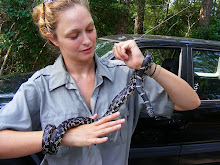
JakeOne is a tall, blond farm boy who grew up raising cattle, and also hell. He loves slow-pitch baseball and thinks vegetables are some sort of mean joke. And as I have mentioned, he is fond of snakes and photography, and terrifying combinations of the two. I am including links to some of his photographs below. There was a night at the house when an Eastern Hognose slid up to me as I was returning phone calls, and I called the guys out to take pictures. A hognose is not poisonous to people, but it is not small, either, and it puffs itself up, gapes, hisses and rattles like a poisonous snake. It will also mimic a cobra, which can cause you to panic if you are at all normal. Jake lay down on the ground next to the hognose and took about a hundred pictures with the snake striking at him. Every picture JakeTwo and I have of this snake has a piece of Jake’s camera lens or Jake himself in it. There is only so close sane people will get to any sort of wildlife regardless of toxicity, but Jake is apparently unaffected by this convention.

Jake immediately impressed me as a wild man, even before I met him. I had been living in the house with him for a number of days before I even saw him. I heard him coming and going, but as he never used the bathroom or kitchen or anything contained within these walls, I had to meet him at work. Events since then have reinforced my first impressions, as when I returned from shorebird surveys to find Jake, surrounded by a group of tired and wet men, skinning a four-foot catfish that he had nailed to the house. Some of the guys had gone hogging—also known as “grabbling” and “noodling”—which is a sport where you walk through a river and stick your fist under rocks until a large fish grabs it in its mouth, at which point, you try to hoist the thing out of the water and wrestle it until it is dead. Yeah, I’m not kidding. You have to let it bite you and clamp onto your wrist, because a catfish is too slippery to hold onto otherwise. An added benefit of noodling around here is that the water is so deep that you need someone to stand on you to keep you down on the riverbed while you are doing this. (Lincoln caught this one with Rupert standing on him.) Oh, and have I mentioned that this is snapping turtle country? No? Watch your fingers.

I tried to skin one side of the catfish, but Jake was cleaner, faster, and had his side skinned and filleted in a matter of minutes, before I even got done assessing the subdermal physiology of the fish. My side was bleeding like a freshly slaughtered cow, and I had the better knife. We had a 30-pound fish fry at work two days later, which might be the field-station equivalent of an office party with a swarm of cupcake-baking secretaries. Why does our workplace have its own deep-fat fryer, you ask? There are no simple answers to questions like this.

JakeTwo is shorter, darker, and tough as titanium jerky, but he has a warm smile and a sometimes-friendly if constantly obscene nature. This is a conversation I overheard between JakeTwo and my boss, and is fairly representative of conversations with JakeTwo:
“So, you think you’ll try your hand at grabbling next time ‘round?” questions Jeff.
“I gotta be honest with you, I just don’t think my testicles are big enough for that,” answers JakeTwo, as directly as possible.
Jeff, not exactly used to being addressed like this, thinks for a minute. “Maybe you could use them as bait?”
“Sir, they’re not even big enough for that.” I won’t transcribe the fire crew conversations that involve JakeTwo, but they are funny. You get the idea.

JakeTwo is also NASCAR fanatic, so his move to North Carolina is a trip to the Promised Land; a homecoming for the True Fan. Through playing NASCAR 07 on the PlayStation2, and watching movies like Days of Thunder and Talladega Nights with JakeTwo (these are basically the same movie except for a puma named Karen, and you can see shots of Rockingham in them if you are curious), I have learned the differences between open-wheel and stock-car racing, what makes a good driver, how you “line up under caution” behind the “pace car,” and how each of the NASCAR raceways differ in terms of shape, turn characteristics, surface friction, and so on. For example, our Rockingham raceway, “The Rock,” has unique track bed characteristics that make it sort of a gem of NASCAR tracks. The Rock is also narrower on one end than the other because it was built to accommodate a small and now non-existent wetlands on one side of the site, so each turn requires a different driving technique and strategy to get through. This is one of those details I cannot help but laugh about, as NASCARs get 4 miles to the gallon, and have a major impact on the local environment. Somewhere there is a point that is being missed.

For his Masters research, JakeTwo tracks and captures cottonmouths alone in remote areas. He should be wearing his medical bracelet with information as to his antivenom allergies, but he isn’t. “They can kill you with their venom, they can open their mouths almost 180 degrees and bite you from any angle, they’re lightning fast, incredibly strong, and they still have six defensive mechanisms so that they don’t have to attack you,” he says, when I ask him what he likes about cottonmouths in particular. I guess there’s something likable about all that, though I still run the other direction when I encounter one. He wants to end up in the Everglades. “Big, flowing water, big snakes,” he says, with that reserved passion of someone who truly loves his work. I’m sure he’ll get there eventually, but we have cottonmouths, and he has a snake hook, so he just might see fit to stay for a while.

What else can I say? The Jakes are good roommates. I am a fortunate girl.


Living in Constant Terror,
Erica